The Verification Imperative: How Water Resilience and Critical Mineral Traceability Are Reshaping Resource Supply Chains
Introduction: Two Sides of the Same Verification Coin
In the high desert of Utah, a technological paradox is unfolding. The state has become a magnet for hyperscale data centers—Google, Meta, and others have poured billions into facilities that guzzle water for cooling. Yet Utah is also in the grip of a decades-long megadrought, with the Great Salt Lake shrinking to record lows. To reconcile these opposing forces, operators are turning to a suite of water-resilience technologies: cloud seeding to wring more precipitation from winter storms, atmospheric water harvesting to pull moisture directly from the air, and advanced low-water cooling systems that recycle every drop. But these solutions face a fundamental problem: without independent, verifiable proof of their effectiveness, investors and regulators remain skeptical.
Simultaneously, a very different but structurally parallel challenge is gripping the critical minerals sector. As the United States tightens export controls on rare earth elements and lithium, and as China refines over 60% of the world’s battery-grade minerals, companies from mining giants to battery manufacturers are racing to build traceability systems that can verify a mineral’s origin, its processing location, its chain of custody, and its environmental and social attributes. Yet here too, a lack of trusted validation—who really knows where a ton of cobalt came from?—stalls adoption.
At first glance, water resilience and critical mineral traceability seem unrelated. But they share a core economic logic: markets increasingly demand independent, credible validation of resource claims. This convergence is giving rise to what analysts are calling the “verification economy”—a new market force that rewards systems capable of proving, rather than merely asserting, that a resource is sustainable, secure, or responsibly sourced. From the data centers of Utah to the lithium brine flats of South America, the same question is being asked: can you prove it?
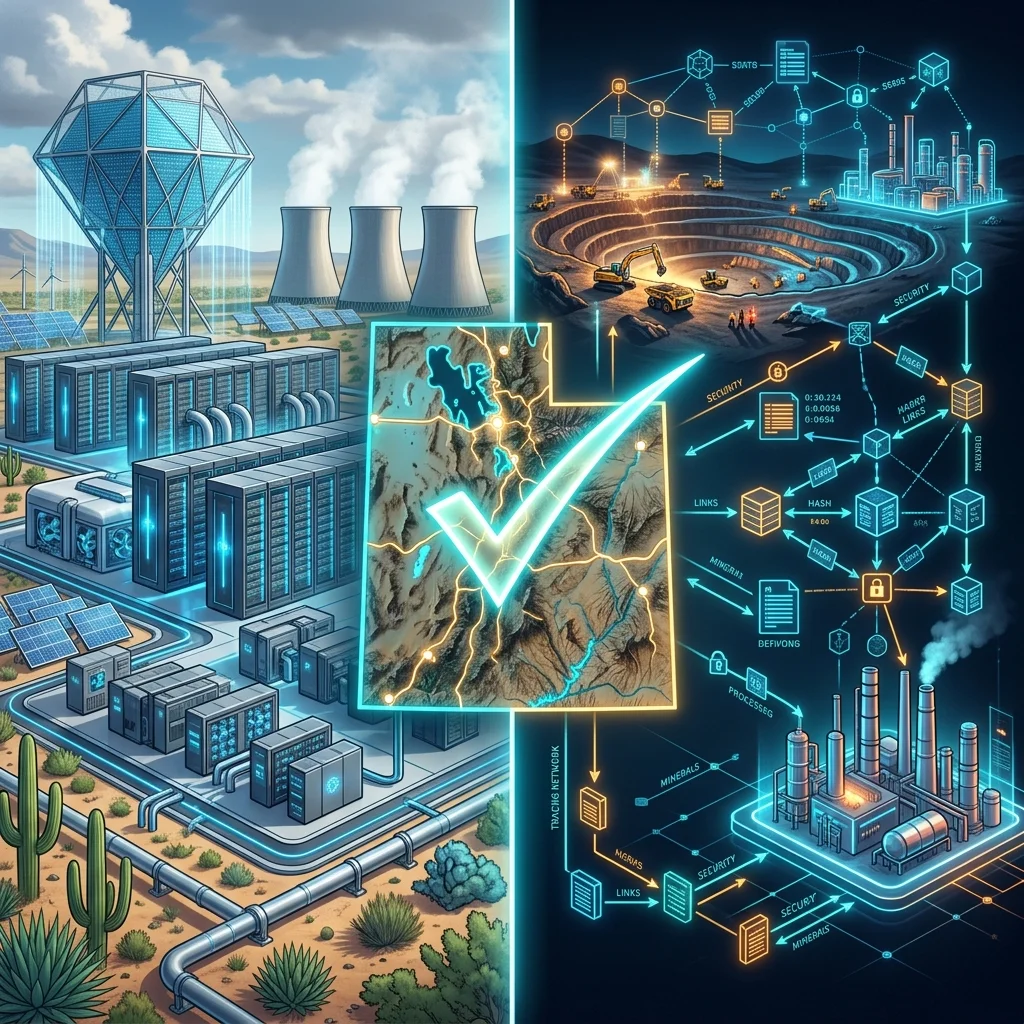
[IMAGE: Side-by-side infographic: data center water cycle on left, mineral supply chain map on right.]
Water Resilience: From Technology to Trust
The technologies themselves are no longer science fiction. Cloud seeding, which uses silver iodide or salt flares to enhance snowfall, has been deployed operationally in Utah for decades. Atmospheric water harvesting devices, which condense humidity using desiccants or cooling coils, are being installed at pilot data centers. Water reuse systems now recycle up to 95% of cooling water in some facilities. And low-water cooling designs—such as direct evaporative and immersion cooling—are slashing consumption by orders of magnitude compared to traditional chillers.
Yet the effectiveness of each technology remains deeply contested. Cloud seeding, for instance, may boost snowfall by 5% to 15% in ideal conditions, but statistical validation is notoriously difficult. A study by the University of Utah’s Department of Atmospheric Sciences found that natural variability often masks the signal of seeding. Atmospheric water harvesting is energy-intensive; in arid climates, the energy cost per liter can rival desalination. Water reuse faces regulatory hurdles and public perception challenges. And low-water cooling may shift the burden from water to energy, depending on local grid mix.
“The missing piece is not the technology,” says Dr. Sarah K. Johnson, a water resilience researcher at the University of Utah’s Wilkes Center for Climate Science and Policy. “It’s the verification framework. Without independent, standardized measurements of water yield, avoided consumption, energy intensity, and watershed-level impacts, these solutions remain uninvestable for institutional capital.”
That verification framework must answer several questions: How much water did this technology actually produce or save, compared to a counterfactual baseline? What are the contaminant risks (e.g., from silver iodide in cloud seeding)? What is the full lifecycle energy cost? And how does the technology affect downstream water users and ecosystems? Answering these requires a combination of real-time sensors, hydrological models, and third-party auditing.
Utah’s unique position—as both a data center hub and a drought-prone region—makes it a microcosm for testing and scaling these verification standards. The state’s Division of Water Resources has been working with researchers to develop a “water budget” certification for data centers, similar to LEED for buildings. Early pilots suggest that verified water-saving technologies can unlock preferential water rights and lower insurance premiums, creating tangible market incentives.
[IMAGE: Graph showing water use vs. data center capacity growth in Utah from 2010 to 2025, with projected trends under verification scenarios.]
Critical Mineral Traceability: Navigating Fragmentation and Control
On the other side of the verification coin, critical mineral supply chains face an equally pressing need for trust—but a far more fragmented landscape. Traceability systems aim to answer four fundamental questions about any ton of mineral: Where was it mined? Where was it processed (crushed, concentrated, refined)? Who handled it along the way? And what are its environmental and social attributes (e.g., carbon footprint, child labor risk, water use)?
The economic logic is clear: automakers like Tesla and Ford are demanding fully traceable lithium and cobalt to meet ESG commitments and comply with emerging U.S. Department of Energy guidelines. Export controls on Chinese rare earths have made origin verification a national security issue. And the Inflation Reduction Act’s battery tax credits require that critical minerals be processed in free-trade-agreement countries—but proving that “processing location” requires tamper-proof data.
Yet adoption of traceability systems is hindered by several barriers, as documented in a recent fact list from the University of Utah’s Kem C. Gardner Policy Institute and discussed in an upcoming Lux Research webinar on supply chain verification:
- High costs: Implementing blockchain or digital twin systems across thousands of small-scale artisanal miners and dozens of mid-stream processors is expensive, often exceeding the margin on the mineral itself.
- Fragmented systems: Each miner, refiner, and OEM uses its own software stack—ERP, IoT, legacy databases—with no common data format.
- Supplier leverage gaps: Small miners have little incentive to invest in traceability when large buyers can simply switch to another source.
- Confidentiality concerns: Sharing chain-of-custody data can reveal proprietary blending ratios or trade secrets.
- Uncertain data quality: Even when data is collected, manual entries and sensor drift introduce errors that undermine trust.
The concentration of refining capacity in a few countries amplifies the urgency. China controls roughly 70% of global lithium refining and over 90% of rare earth processing. A single export ban could cascade through the supply chain. Transparent and secure tracking is no longer a nice-to-have; it is a buffer against geopolitical disruption.
Emerging solutions include blockchain-based platforms that immutably record each transaction, digital twins that simulate material flows, and interoperable standards like the Global Battery Alliance’s Battery Passport. Yet scalability remains elusive. A pilot by the Responsible Minerals Initiative in the Democratic Republic of Congo found that while blockchain reduced fraud in cobalt shipments by 40%, the cost per container increased by 25%. For high-value lithium, that premium may be acceptable; for lower-value minerals like graphite, it is not.
[IMAGE: Diagram of critical mineral supply chain from mine to refinery with traceability checkpoints, showing data flow and verification nodes.]
Common Challenges and the Role of Academic Research
The parallels between water resilience verification and critical mineral traceability are striking. Both sectors face the same three foundational hurdles:
1. Lack of interoperable systems: Water measurement tools from different vendors produce data in proprietary formats; mineral traceability platforms from different consortia speak different languages. Neither sector has agreed on a common data protocol or certification standard.
2. High integration costs: Retrofitting existing data center cooling towers with water meters and real-time sensors costs tens of thousands of dollars per unit. Similarly, equipping a small artisanal mine with GPS-tracked bags and QR codes can strain a miner’s entire annual operating budget.
3. Resistance from powerful incumbents: In water, utilities and large data center operators sometimes resist transparency because it could reveal inefficiencies or trigger regulatory action. In minerals, major refiners may oppose traceability because it threatens their control over provenance claims.
Academic research is beginning to address these challenges head-on. At the University of Utah, an interdisciplinary team from the College of Engineering, the Wilkes Center, and the Kem C. Gardner Policy Institute has launched a joint “Verification Science Initiative” that examines both water and mineral supply chains. The team is developing an open-source “Verification Ontology”—a standardized vocabulary and data model that can describe water yield claims in the same language as mineral origin claims.
“We realized that the data structures are remarkably similar,” explains Dr. Michael Chen, a computer scientist leading the ontology project. “Whether you’re tracking liters of reclaimed water or kilograms of lithium ore, you need a unique identifier, a timestamp, a location, a measurement, and a signature. The verification logic is identical.”
The initiative is also piloting a “trust-by-design” approach that uses cryptographic proofs—zero-knowledge proofs in particular—to allow data center operators to prove they saved a certain volume of water without revealing their proprietary cooling system design. Similarly, mineral processors can prove they sourced from a specific mine without disclosing contract terms. This addresses the confidentiality barrier.
Opportunities for Interoperable Standards and Scalable Models
The emergence of the verification economy creates significant opportunities for those who can build bridges. The first is the development of interoperable standards that span water and minerals. For example, the World Resources Institute’s Aqueduct Water Risk Atlas already provides watershed-level water stress data. If a mineral traceability platform could embed that water risk score at the mining stage, it would add a crucial sustainability layer. Conversely, water resilience certificates issued to a data center could be traded or retired in a carbon-credit-like market, creating a revenue stream for early adopters.
The second opportunity lies in scalable traceability models that push costs down through automation and economies of scale. In the minerals sector, consortia like the Global Battery Alliance and the European Raw Materials Alliance are already working on shared registry platforms. A similar model for water resilience—perhaps a “Water Trust Registry” that records verified water yield and avoided consumption claims—could be piloted in Utah and replicated in other arid regions like the Middle East and Australia.
Third, the verification economy rewards innovation in verification itself. Startups developing hyperspectral sensors that can distinguish mined from recycled lithium, or AI-powered weather models that improve cloud seeding attribution, will find ready buyers. The same is true for companies building decentralized identity frameworks that allow small-scale miners to maintain anonymized but verifiable profiles.
[IMAGE: Concept art of a unified verification dashboard showing water resilience metrics (left) and mineral traceability metrics (right), with a shared trust score in the center.]
Conclusions: A Unified Verification Economy
The convergence of water resilience and critical mineral traceability is not a coincidence. It reflects a deeper structural shift in resource supply chains: the era of opaque, trust-based transactions is ending. Whether the claim is “this data center uses 40% less water” or “this lithium was processed in a free-trade-agreement country,” the market increasingly requires independent proof. Investors, regulators, and consumers are no longer satisfied with promises.
Utah, with its data center boom and drought crisis, is a natural laboratory for this new paradigm. The state’s academic institutions—especially the University of Utah—are positioned to lead by developing the verification standards, ontologies, and pilot projects that will define the verification economy. The challenges remain significant: fragmentation, cost, incumbent resistance, and data quality. But the opportunities—for interoperable standards, scalable models, and new verification technologies—are equally large.
As the resources that power the digital economy become more contested, the ability to verify will become a competitive advantage. The verification imperative is here. Industries, policymakers, and innovators who embrace it will shape the next generation of resilient, transparent resource supply chains.
---
*This article draws on research from the University of Utah’s Wilkes Center for Climate Science and Policy, the Kem C. Gardner Policy Institute, and the College of Engineering, as well as insights from the upcoming Lux Research webinar on supply chain verification systems. For more information on market trends in verification technologies, contact the University of Utah’s Office of Technology Licensing.*