Unlocking Opportunities in Emerging Markets: Insights from the International Conference on Emerging Market Dynamics and Global Trade (EMDGT23)
The International Conference on Emerging Market Dynamics and Global Trade (EMDGT23), held entirely online on December 8-9, 2023, from Greater Noida, India, brought together researchers, academics, and industry leaders to dissect the forces reshaping emerging economies. Against a backdrop of post-pandemic recovery, supply chain realignments, and geopolitical fragmentation, the conference explored how shifting trade policies, digital innovation, and sustainability create both risks and opportunities. This article unpacks the core themes of EMDGT23—from economic transformation and supply chain dynamics to geopolitical risk and consumer behavior—and examines their real-world implications for businesses and policymakers. By analyzing the conference’s structure, award categories, and key discussions, we highlight a growing emphasis on bridging academic research with practical, cross-border strategies. The insights reveal a pivotal moment for emerging markets to leverage digital platforms and collaborative knowledge exchange in a rapidly changing world.
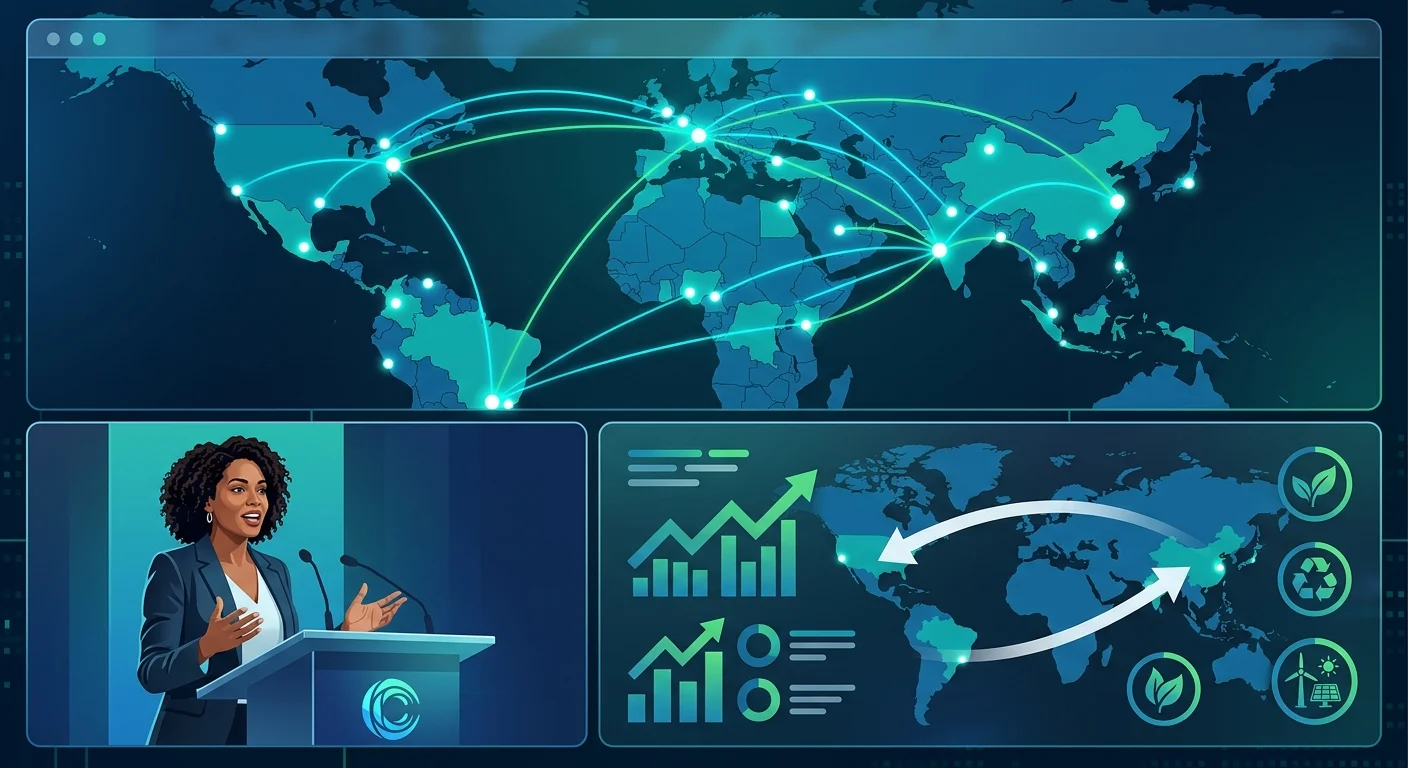
[IMAGE: A stylized virtual conference interface showing a world map with glowing dots connecting major emerging market cities like Mumbai, Shanghai, and São Paulo. In the foreground, a split screen displays a keynote speaker and a dynamic data dashboard with trade flow arrows, upward trends, and sustainability icons. No text, no watermarks. Modern, clean, professional design with blue and green tones.]
1. Setting the Stage: EMDGT23 in a Post-Pandemic World
EMDGT23 was hosted fully online by the KCC Institute of Technology and Management in Greater Noida, India, on December 8-9, 2023. This virtual format symbolized a broader shift in global academic discourse: as physical borders recede, knowledge exchange becomes more inclusive. The conference’s tagline, “Unlocking Opportunities in a Changing World,” directly captured the volatile trade environment shaped by post-pandemic recovery, supply chain realignments, and geo-economic fragmentation.
The tight timeline—abstract registration closed on November 25, 2023, with full papers due by December 2—underscored the event’s high-intensity, fast-track nature. This compressed schedule encouraged participants to submit cutting-edge research addressing urgent, real-time issues. For emerging markets, where data and policy changes move rapidly, such agile formats are increasingly vital.
[IMAGE: A timeline infographic showing key dates: Abstract submission deadline Nov 25, Full paper deadline Dec 2, Conference dates Dec 8-9, with a virtual conference banner reading “EMDGT23 – Unlocking Opportunities in a Changing World”.]
The online model also lowered participation barriers for researchers from developing countries, who often face visa hurdles, high travel costs, or limited institutional support. By hosting the event from Greater Noida—a satellite city of Delhi—but making it globally accessible, EMDGT23 demonstrated how digital platforms can democratize academic discourse. This approach aligns with the conference’s core audience: academics, policymakers, and business strategists focused on emerging economies in Asia, Africa, and Latin America.
2. Core Themes: Navigating Economic Transformation and Global Trade Policy
EMDGT23 structured its call for papers around ten interconnected themes: economic transformation, global trade policies, innovation and technology, supply chain dynamics, investment strategies, sustainability, geopolitical factors, and consumer behavior, among others. These themes are not isolated; they form a holistic map of the forces reshaping emerging markets.
A deep insight from the conference program is the pairing of “global trade policies” with “geopolitical factors.” This indicates a growing recognition that trade is no longer purely economic—it is a strategic tool. Emerging markets must now navigate sanctions, tariff wars, and regional bloc alignments. For example, the ongoing U.S.-China trade tensions and the rise of the “China+1” strategy have pushed multinational corporations to diversify production bases. Countries like India, Vietnam, and Mexico are positioning themselves as alternative manufacturing hubs, a shift that directly impacts supply chain dynamics and investment strategies in these regions.
Sustainability emerged as a standalone theme, reflecting how environmental regulation is becoming a non-tariff barrier and a competitive differentiator. For companies operating in India, Southeast Asia, and Africa, complying with carbon border adjustment mechanisms (CBAM) in Europe or meeting ESG (Environmental, Social, and Governance) standards demanded by global investors is no longer optional. Case studies presented at EMDGT23 examined how firms in emerging markets are incorporating circular economy principles and renewable energy to stay competitive in global trade.
[IMAGE: A mind map connecting the ten conference themes with arrows showing interlinkages. Central node: “Emerging Market Dynamics”. Branches: Economic Transformation, Global Trade Policies, Innovation & Technology, Supply Chain Dynamics, Investment Strategies, Sustainability, Geopolitical Factors, Consumer Behavior, etc.]
Consumer behavior also received dedicated attention. The post-pandemic surge in digital adoption has fundamentally changed purchasing patterns in emerging markets. From Indonesia to Nigeria, consumers increasingly rely on mobile platforms for everything from groceries to financial services. Understanding these shifts is critical for businesses seeking to tailor products, pricing, and distribution channels.
3. The Digital Advantage: How Online Conferences Amplify Knowledge Exchange
EMDGT23’s fully online model—hosted from Greater Noida but accessible globally—allowed for broader participation than a physical conference, lowering barriers for researchers from developing countries. This is particularly relevant for emerging markets where academic budgets are often constrained. The virtual format also enabled real-time polling, breakout rooms, and chat-based Q&A, facilitating deeper interaction than a traditional lecture hall.
One notable feature was the conference’s emphasis on bridging academic research with practical, cross-border strategies. The award categories—Best Paper, Best Presentation, and Best Industry-Academia Collaboration—specifically recognized work that demonstrates real-world applicability. For instance, the “Best Industry-Academia Collaboration” award encouraged researchers to partner with businesses and policymakers, ensuring that findings translate into actionable insights for business strategy and economic transformation.
The conference also featured keynote sessions from industry leaders who shared firsthand experiences navigating trade disruptions. A session on “Supply Chain Resilience in a Fragmented World” highlighted how companies in India and Southeast Asia are using digital twins and AI-driven demand forecasting to mitigate risks. Another panel on “Fintech as a Catalyst for Financial Inclusion” showcased how startups in Kenya and Brazil are leveraging mobile money to unlock credit for small businesses—a key driver of emerging market growth.
[IMAGE: A screenshot of a virtual breakout room with four participants from different time zones discussing a slide titled “Supply Chain Resilience Strategies”. A chat panel shows comments from attendees in India, Brazil, and Nigeria.]
The digital format also enabled real-time data sharing. Presenters could embed dynamic dashboards showing trade flow arrows, upward trends in FDI, and sustainability metrics. This visual approach made complex topics more accessible to a diverse audience, ranging from PhD students to corporate strategists.
4. Real-World Implications for Businesses and Policymakers
The insights from EMDGT23 carry concrete implications for two key stakeholder groups: multinational corporations and government agencies.
For businesses, the conference underscored the urgency of adopting a “multi-hub” supply chain strategy. Relying on a single manufacturing base—even one as efficient as China—exposes firms to geopolitical and pandemic-related disruptions. Emerging markets like India, Vietnam, and Thailand offer not only lower labor costs but also improving infrastructure and trade agreements. However, companies must also navigate local regulatory complexities, corruption risks, and skill shortages. The conference’s sessions on investment strategies provided frameworks for evaluating these trade-offs, including the use of political risk insurance and joint ventures with local partners.
For policymakers, the discussions highlighted the need to create ecosystems that attract foreign direct investment while building domestic capabilities. This means investing in digital infrastructure, streamlining customs procedures, and aligning environmental standards with global norms. India’s Production-Linked Incentive (PLI) scheme and Vietnam’s free trade agreements were cited as successful models. At the same time, governments must address social inequalities that digital transformation can exacerbate—a theme explored in the “consumer behavior” and “sustainability” tracks.
[IMAGE: A split infographic showing “Business Implications” on one side (supply chain diversification, ESG compliance, digital adoption) and “Policy Implications” on the other (infrastructure investment, trade facilitation, skill development). Arrows connect both sides to a central globe representing emerging markets.]
5. Looking Ahead: Emerging Markets at a Crossroads
EMDGT23 made clear that emerging markets stand at a crossroads. The convergence of digital innovation, shifting trade policies, and sustainability demands creates both unprecedented opportunities and formidable challenges. For example, the rise of global trade fragmentation—exemplified by regional blocs like the Indo-Pacific Economic Framework (IPEF) and the African Continental Free Trade Area (AfCFTA)—offers emerging economies new avenues for South-South cooperation. Yet it also risks locking them into lower-value supply chain roles if they fail to upgrade their technological and institutional capacities.
The conference’s emphasis on conference insights as a bridge between academia and practice suggests a growing recognition that no single entity can navigate this complexity alone. Collaborative platforms like EMDGT23, especially when conducted online, enable the rapid diffusion of knowledge across borders. The tight timeline for submissions and the focus on real-time issues mean that findings are immediately relevant, not years old.
As the world moves toward 2024, the lessons from EMDGT23 will resonate. For researchers, the conference provides a rich vein of data and theoretical frameworks. For business leaders, it offers a roadmap for de-risking operations in volatile environments. And for policymakers, it underscores the importance of agility—the ability to adapt trade strategies as geopolitical currents shift. The online format, hosted from Greater Noida, has set a precedent for how future conferences can democratize access to cutting-edge knowledge, ensuring that voices from emerging markets are not just heard but centered.
[IMAGE: A futuristic globe with glowing network lines connecting cities like Mumbai, Shanghai, São Paulo, and Lagos. In the foreground, a silhouette of a person viewing a holographic dashboard with terms like “EMDGT23”, “Supply Chain Resilience”, and “Sustainability”. No text, professional blue and green tones.]
The real measure of EMDGT23’s success will be whether the ideas exchanged during those two December days translate into tangible policies, investment decisions, and business innovations. If the conference’s themes are any guide, the emerging markets of 2030 will look very different—more digital, more sustainable, and more interconnected—but also more strategically contested. Understanding those dynamics is the first step toward unlocking the opportunities that lie ahead.