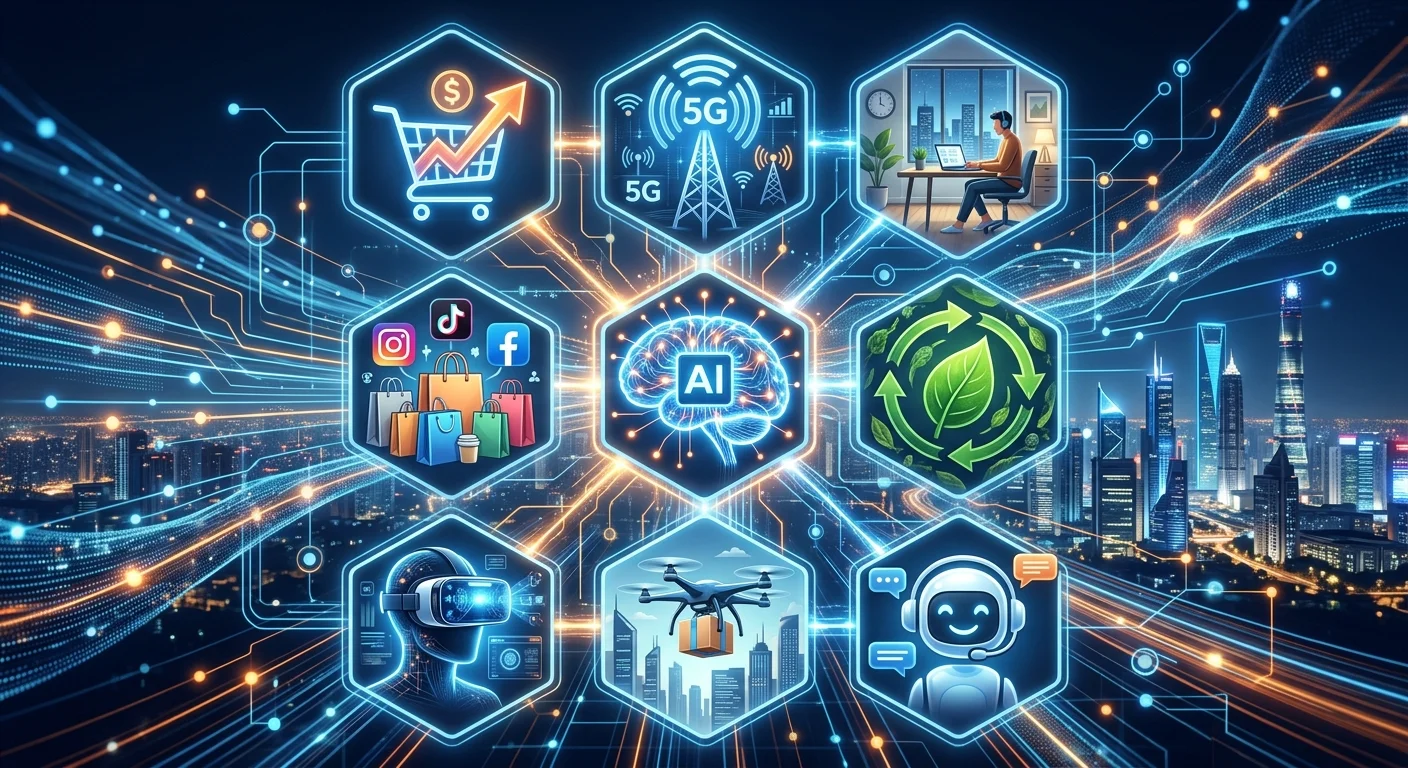
9 Business Trends Defining 2026: The AI-Powered Future of Work, Commerce, and Innovation
Introduction: The AI Revolution as the Central Axis of 2026
Generative AI is no longer a standalone trend—it has become the invisible engine powering nearly every other business transformation, from e-commerce personalization to last-mile delivery optimization. In 2026, the convergence of nine key trends reveals a single underlying logic: artificial intelligence is amplifying productivity, reshaping customer expectations, and redefining operational efficiency across industries.
Market data confirms the scale of this shift. According to Visual Capitalist, generative AI applications are expected to generate over $10 billion in consumer spending in 2026, while Grand View Research projects the market will grow from $22.21 billion in 2025 to $324.68 billion by 2033. These figures are not speculative—they reflect real enterprise adoption and consumer uptake. A recent Accenture survey found that 98% of global executives believe AI models will play an important role within five years, and a majority of employees already report that AI has increased their productivity.
This article unpacks the nine top trends defining the 2026 business landscape and reveals how AI acts as the hidden economic logic behind each one.
[IMAGE: Infographic showing GenAI market growth curve from 2025 to 2033 with key milestones (2022 ChatGPT launch, 2026 $10B spend, 2030 final-draft AI content).]
---
1. Generative AI Boosts Productivity Across Industries
The most direct impact of generative AI is on workplace productivity. Original research shows that a majority of employees who use AI tools report measurable improvements in output quality and speed. GitHub Copilot, for example, is now used by more than 400 organizations, helping developers write code faster with fewer errors. BCG forecasts that by 2030, generative AI will be capable of producing "final draft" content in areas such as marketing copy, legal documents, and financial reports.
A rising sub-trend is synthetic data generation. Companies like Syntegra are enabling privacy-preserved AI training by creating realistic but artificial datasets. Search volume for the term "synthetic data" has jumped 608% over five years, signaling a fundamental shift in how organizations approach data scarcity and regulatory compliance.
This productivity boost is not limited to tech companies. Manufacturers use AI to optimize supply chains, retailers use it to automate customer service, and healthcare providers use it to accelerate drug discovery. The trend is pervasive and accelerating.
[IMAGE: Dashboard showing productivity metrics before and after AI adoption, with icons for Copilot, synthetic data, and LLM usage.]
---
2. E-Commerce Growth Persists, Fueled by AI Personalization
Online retail continues to expand in 2026, but the differentiation now comes from AI-driven personalization rather than mere product availability. BERT-level large language models power recommendation engines that achieve 85–90% accuracy in milliseconds, dynamically adjusting product suggestions based on real-time browsing behavior, purchase history, and even sentiment analysis.
Consumer trust is high: nearly 70% of shoppers believe most businesses will soon use AI to improve customer experience, creating a positive feedback loop that accelerates adoption. This trust fuels higher conversion rates and average order values, while also reducing return rates through better fit and relevance predictions.
Behind the scenes, AI optimizes inventory management and dynamic pricing. Retailers can predict demand fluctuations with greater precision, reducing stockouts and overstock situations. The result is a more efficient e-commerce ecosystem where personalization becomes the competitive moat.
[IMAGE: Split screen: left side shows traditional online shopping cart, right side shows AI-powered personalized product recommendations with user satisfaction scores.]
---
3. 5G Vastly Improves Data Collection and AI Capabilities
The rollout of 5G networks has reached critical mass in 2026, enabling near-instant data transmission that allows AI models to process real-time information from billions of IoT devices. In manufacturing, 5G-connected sensors feed AI systems that predict equipment failures before they occur—reducing downtime by up to 30% in some early adopters.
For customer-facing applications, 5G enables seamless augmented reality try-ons, real-time video customer support with AI voice agents, and immersive shopping experiences that were previously impossible due to latency. The combination of 5G and edge computing means AI decisions happen in milliseconds, not seconds.
This trend also underpins smart city initiatives, autonomous vehicle fleets, and precision agriculture. The data collected through 5G networks fuels ever-more sophisticated AI models, creating a virtuous cycle of improvement.
[IMAGE: Diagram showing 5G tower connecting IoT devices to an AI processing hub with real-time data streams.]
---
4. Remote Work Matures into Hybrid Intelligence
By 2026, remote work has evolved beyond a pandemic-era necessity into a permanent hybrid framework that relies heavily on AI coordination tools. Virtual collaboration platforms now integrate AI agents that summarize meetings, assign action items, and even predict team bottlenecks. The concept of "hybrid intelligence"—where human workers and AI cocreate solutions—is becoming standard.
Employee sentiment has shifted from resistance to acceptance, with many reporting that AI tools reduce administrative overhead and allow them to focus on higher-value tasks. Companies that invest in AI-powered onboarding, performance tracking, and asynchronous communication are outperforming peers in employee retention and productivity.
The trend also reshapes office space utilization, with commercial real estate repurposed for collaboration hubs rather than fixed desks. AI tools help schedule optimal in-office days to maximize team interaction.
[IMAGE: Illustration of a hybrid worker at home with AI assistant scheduling tasks, while colleagues appear in a virtual meeting room.]
---
5. Social Commerce Becomes a Primary Sales Channel
Social media platforms have fully transformed into shopping destinations. In 2026, social commerce accounts for a significant and growing share of e-commerce revenue, driven by AI-powered shoppable posts, live-stream selling, and influencer recommendation engines. Algorithms analyze user engagement patterns to surface products at the exact moment of purchase intent.
Platforms now integrate AI chatbots that handle everything from sizing questions to checkout, reducing friction. For brands, the key is authentic integration: users want discovery and purchase to feel seamless, not interruptive. AI helps brands tailor content to micro-audiences, increasing click-through rates by as much as 300% according to industry benchmarks.
The trend is especially strong in fashion, beauty, and home goods, where visual discovery and social proof drive conversions.
[IMAGE: Social media feed with embedded shop icons and a live-stream seller interacting with viewers, showing product tags.]
---
6. Sustainability Moves from Compliance to Competitive Advantage
Sustainability in business is no longer a checkbox—it is a core driver of brand loyalty and operational efficiency. In 2026, AI plays a central role in tracking carbon footprints, optimizing energy use, and managing supply chain emissions. Companies like Watershed and Persefoni use AI to model emission scenarios and recommend reduction strategies.
Consumers increasingly expect transparency: 70% of global shoppers say they would pay a premium for sustainably produced goods, and AI-powered blockchain solutions now provide verifiable product provenance. This trend intersects with circular economy models, where AI helps design products for easier recycling and identifies secondary markets for used goods.
Regulatory pressure is also growing, with the EU’s Corporate Sustainability Reporting Directive (CSRD) requiring detailed disclosures. AI automates the data collection and reporting process, reducing compliance costs.
[IMAGE: Green leaf icon connected to AI analytics dashboard showing energy savings, carbon reduction curves, and recycling metrics.]
---
7. Immersive Technologies Reshape Customer Experience
Augmented reality (AR), virtual reality (VR), and mixed reality (MR) have moved beyond gaming into mainstream business applications. AI is the bridge that makes immersive experiences practical and personalized. Virtual try-ons for eyeglasses, furniture placement in rooms, and even virtual test drives are now standard in retail.
In training and development, VR simulations powered by AI adapt to each learner’s pace, providing real-time feedback. Healthcare uses immersive tools for surgical planning and patient education. The global immersive technology market is projected to exceed $50 billion by 2027, with AI serving as the underlying intelligence layer.
The convergence of 5G, edge computing, and lightweight headsets has lowered the barrier to entry, making immersive technology accessible for small and medium businesses.
[IMAGE: Person wearing VR goggles interacting with a 3D product model, with AI data analytics overlays in the view.]
---
8. Last-Mile Delivery Innovation Driven by AI
Last-mile delivery—the most expensive and complex part of the logistics chain—is being reinvented through AI. Autonomous drones, sidewalk robots, and AI-optimized routing systems are reducing delivery times and costs. In 2026, major players like Amazon, FedEx, and local startups are deploying these technologies at scale.
AI predictions determine optimal delivery windows, consolidate routes, and even anticipate weather disruptions. For customers, real-time tracking with AI-powered estimated arrival updates has become the norm. The trend is closely tied to e-commerce growth: faster and cheaper delivery increases conversion rates and customer satisfaction.
Grubhub and other food delivery platforms are using AI to predict restaurant preparation times, reducing driver wait times and improving efficiency. The environmental impact is also reduced through consolidated routes and electric delivery fleets managed by AI.
[IMAGE: Delivery drone flying over a city street with an AI route optimization map on a tablet below.]
---
9. AI Customer Experience Becomes a Strategic Differentiator
Customer experience (CX) has long been a competitive differentiator, but in 2026, AI raises the bar. Chatbots and voice assistants powered by generative AI can handle complex, multi-turn conversations with empathy and accuracy. Sentiment analysis tools detect dissatisfaction early and trigger proactive interventions.
Companies that invest in omnichannel AI CX—where a single AI engine tracks interactions across web, mobile, social, and in-store—see higher Net Promoter Scores (NPS) and reduced churn. AI also enables hyper-personalized loyalty programs, offering rewards based on individual behavior rather than arbitrary segments.
The trust factor is critical: nearly 70% of consumers believe most businesses will soon use AI to improve CX, but they also expect transparency about when they are interacting with an AI. Brands that communicate clearly and deliver consistent quality will win loyalty.
[IMAGE: Customer service chatbot interface showing a positive interaction, with an AI sentiment analysis graph displaying satisfaction scores over time.]
---
Conclusion: The Common Thread
The nine trends of 2026 are not isolated phenomena. Generative AI is the connective tissue that amplifies e-commerce personalization, enables real-time 5G data processing, optimizes last-mile logistics, and makes immersive experiences practical. For business leaders, the message is clear: AI is not a separate initiative—it must be embedded into every strategy, from product development to customer engagement.
The data speaks for itself: $10 billion in consumer spending, $324 billion market size by 2033, and 98% executive recognition of AI’s importance. Those who ignore these trends risk obsolescence; those who harness them will define the next decade of commerce and innovation.
[IMAGE: Network diagram showing nine interconnected icons (AI brain, cart, 5G tower, remote worker, social media, leaf, VR goggles, drone, chatbot) with a central AI hub glowing in the background.]